Cookie Privacy Preferences
We utilize essential cookies to ensure our website operates effectively and remains secure. Additionally, we'd like to request your permission to use optional cookies. These are intended to enhance your browsing experience by offering personalized content, displaying advertisements that are relevant to you, and helping us to further refine our website.
Choose "Accept all cookies" to agree to the use of both essential and optional cookies. Alternatively, select "Let me see" to customize your preferences.
Privacy Preference Centre
Our website utilizes cookies to enhance your browsing experience and to present you with content tailored to your preferences on this device and browser. Below, you will find detailed information about the function of cookies, enabling you to make informed choices about which cookies you wish to accept. Please note that disabling certain cookies might impact your user experience on our site. It's important to remember that cookie preferences need to be set individually for each device and browser you use. Clearing your browser's cache may also remove your cookie settings. You have the freedom to modify your cookie preferences at any point in the future.
For a comprehensive understanding of our use of cookies, please refer to our complete cookies policy.
These cookies are needed for the website to work and for us to fulfil our contractual obligations. This means they can't be switched off. They enable essential functionality such as security, accessibility and live chat support. They also help us to detect and prevent fraud. You can set your browser to block or alert you about these cookies, but it means some parts of the site won't work.
These cookies allow us to measure and improve the performance of our site. They help us to know how popular pages are, and to see how visitors move around the site. If you don't allow these cookies, we won't know when you've visited our site, and we won't be able to monitor its performance.
These cookies enable us to provide enhanced functionality and personalisation. They may be set by us or by third party providers whose services we've added to our pages. If you don't allow these cookies, some or all of these services may not work properly.
These cookies collect information about your browsing habits to show you personalised adverts. They may be used to build a profile of your interests and show you relevant adverts on other sites. They don't store directly personal information, but are based on uniquely identifying your browser and internet device. If you don't allow these cookies, the adverts you see will be less relevant.
Freephone 0808 1000 888 | sales@evident.co.uk

Tablet
Mobile
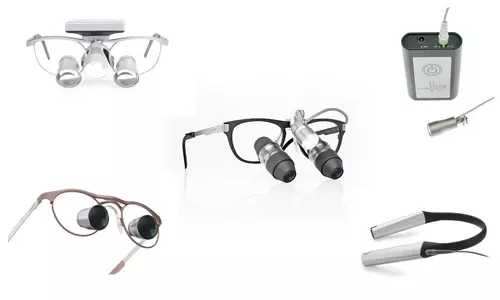
When you choose loupes, magnification is often the first number everyone talks about… 2.5×, 3.3×, 4.8× and beyond. The “right” magnification is the one that gives you clear detail, a comfortable posture and a practical view of the mouth for the way you work every day.
What magnification actually changes
Magnification affects three key parts of your visual experience through dental loupes:
Each step up in magnification is therefore a trade‑off: more detail within a smaller, more sensitive working window.
Common magnification ranges in clinical practice
Most clinical loupes for dentistry and medicine sit within two broad bands of magnification:
Lower magnifications are widely used for general dentistry, hygiene and broader surgical fields, where a generous field of view and comfortable depth of field are important. Higher magnifications tend to be chosen for more intricate, confined work such as endodontics, microsurgery or fine aesthetic detail, where additional magnification genuinely supports clinical precision.
Start with your field of practice
Your day‑to‑day procedures should guide your first magnification choice:
There is no single magnification that suits every clinician. The best choice depends on your clinical focus, posture and visual preferences.
Field of view and depth of field
Two concepts sit alongside magnification: field of view and depth of field.
As magnification rises, field of view and depth of field generally become narrower. For many clinicians, a slightly lower magnification that offers a wider, deeper view can be more efficient than a very high power that constantly requires fine repositioning.
Your vision and working distance
Your own eyesight and posture play a crucial role in how magnification feels.
A magnification that gives a sharp image but forces you to lean or twist soon becomes uncomfortable, however impressive the optics look.
Choosing your first magnification
For a first pair of loupes, many UK clinicians find that a modest magnification is the most versatile starting point.
A practical approach is to:
Magnification is something you can step up to over time as your technique and ergonomic set‑up mature.
When higher magnification is useful
Higher magnification can be particularly beneficial when:
In these scenarios, the smaller field of view is an accepted compromise because the extra detail directly supports the precision of your work, assuming your loupes are well fitted and properly illuminated.
Don’t forget illumination
Magnification and illumination are closely linked. As magnification increases, the image can appear darker, especially in deeper cavities or under challenging lighting conditions.
Pairing your loupes with a high‑quality loupe light helps:
When you compare magnifications, do so with the lighting you will actually use in your surgery. Assessing higher powers without appropriate illumination can make them seem less practical than they really are.
Why a professional fitting matters
Choosing magnification from a specification sheet is very different from experiencing it in your own operatory.
A professional fitting with a specialist provider like Evident allows you to:
This kind of tailored guidance helps you select a magnification that supports your vision and your working style.
Here at Evident, we have been supporting UK dentistry for 50 years and supplying loupes for over 30 years, with excellence, care and innovation in every solution. Whether you are choosing your first loupes or refining your current set‑up, our team can help you select the most suitable magnification, fit your system precisely and pair it with the right loupe light for your practice.