Cookie Privacy Preferences
We utilize essential cookies to ensure our website operates effectively and remains secure. Additionally, we'd like to request your permission to use optional cookies. These are intended to enhance your browsing experience by offering personalized content, displaying advertisements that are relevant to you, and helping us to further refine our website.
Choose "Accept all cookies" to agree to the use of both essential and optional cookies. Alternatively, select "Let me see" to customize your preferences.
Privacy Preference Centre
Our website utilizes cookies to enhance your browsing experience and to present you with content tailored to your preferences on this device and browser. Below, you will find detailed information about the function of cookies, enabling you to make informed choices about which cookies you wish to accept. Please note that disabling certain cookies might impact your user experience on our site. It's important to remember that cookie preferences need to be set individually for each device and browser you use. Clearing your browser's cache may also remove your cookie settings. You have the freedom to modify your cookie preferences at any point in the future.
For a comprehensive understanding of our use of cookies, please refer to our complete cookies policy.
These cookies are needed for the website to work and for us to fulfil our contractual obligations. This means they can't be switched off. They enable essential functionality such as security, accessibility and live chat support. They also help us to detect and prevent fraud. You can set your browser to block or alert you about these cookies, but it means some parts of the site won't work.
These cookies allow us to measure and improve the performance of our site. They help us to know how popular pages are, and to see how visitors move around the site. If you don't allow these cookies, we won't know when you've visited our site, and we won't be able to monitor its performance.
These cookies enable us to provide enhanced functionality and personalisation. They may be set by us or by third party providers whose services we've added to our pages. If you don't allow these cookies, some or all of these services may not work properly.
These cookies collect information about your browsing habits to show you personalised adverts. They may be used to build a profile of your interests and show you relevant adverts on other sites. They don't store directly personal information, but are based on uniquely identifying your browser and internet device. If you don't allow these cookies, the adverts you see will be less relevant.
Freephone 0808 1000 888 | sales@evident.co.uk

Tablet
Mobile
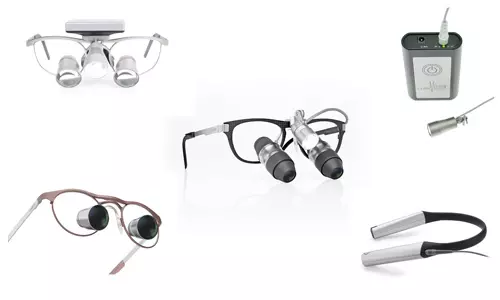
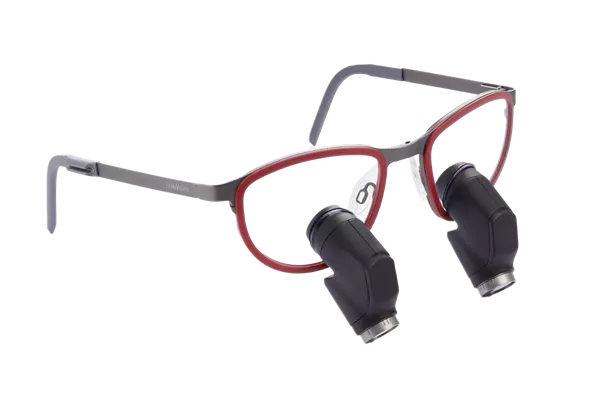
Reflective dental loupes take a different approach to the viewing path. Rather than looking directly through forward-facing optical barrels, they use a reflective optical system to redirect the image from the treatment area.
This allows the clinician to look downwards towards the patient's mouth while maintaining a more upright head position, without relying on the same forward-facing viewing angle as conventional designs.
The choice between straight-through and reflective loupes isn't simply a question of which design offers better posture. Both can be configured to support a comfortable working position. For many clinicians, correctly fitted straight-through loupes will be entirely suitable, while others may benefit from a reflective design because of their particular working position or clinical requirements.
Several factors influence the right choice, including clinician height, patient positioning, working distance and individual anatomy.
Working distance is particularly important. It refers to the space between the clinician's eyes and the treatment area. If the loupes aren't measured and fitted correctly, maintaining focus may require unnecessary adjustments to head or body position.
Other optical considerations include magnification, field of view, depth of field and interpupillary distance. These all influence how easily a clinician can see and work.
The ExamVision Kepler Reflekt uses a reflective optical system to redirect the viewing path, offering an alternative to conventional straight-through loupe designs.
According to its product information, the range is available in 4.0x and 6.0x magnification. It also offers peripheral vision, allowing wearers to interact with patients, colleagues and their surroundings without removing their loupes.
This can be particularly useful when moving between detailed clinical work and everyday interactions within the surgery.
As with any loupe system, higher magnification isn't automatically better. It can affect field of view and depth of field, so the appropriate specification depends on the procedures being performed and the clinician's preferences.
Straight-through and reflective loupes serve the same fundamental purpose, but their different optical designs create distinct viewing experiences. Neither is universally better than the other. The right choice depends on individual requirements, clinical routines and working position.
Correct measurement and customisation are essential regardless of the design. Factors such as declination angle, working distance and magnification should all be considered when selecting a pair.
A professional demonstration can help assess these factors and explore which optical arrangement is most suitable for your needs.
Evident Dental offers demonstrations of the ExamVision Kepler Reflekt range, allowing clinicians to explore its reflective optical design and decide whether it suits their working requirements. With knowledgeable guidance and a personalised approach to fitting, the aim is to help every clinician find a loupe configuration that works for them.